

IN this paper each week are a number of puzzles and games that can be played.
There is a particular one that I seek to answer that tries my patience and eyesight so much.
There are two identical pictures that one has to find the five or more differences in.
Talking of differences have you ever noticed the varieties of ladybirds in your garden.

Those insects are beneficial to our crops.
They alight ever so lightly on the leaves and are a predator against soft bodied insect pests like aphids that can destroy plants in your garden.
There are over 100 species in Australia and most of us know them as little oval domed insects with large wings and range in size from 1-10 mm depending on their species.
According to ‘Gardening Australia” there are four common garden species of ladybird in Australia.
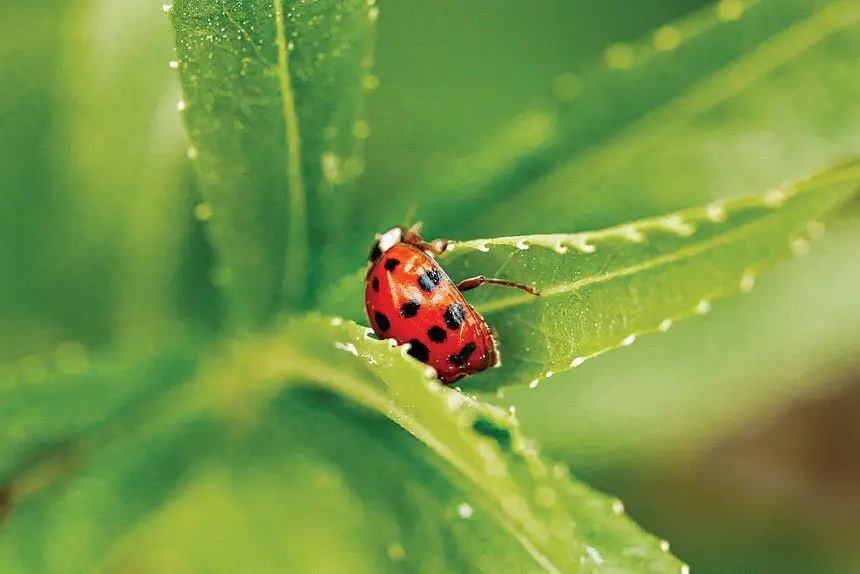
The common spotted ladybird is bright orange with black spots on its back, when they sense danger they exude a yellow liquid which is strong and bitter tasting.
The villain of our species is the light orange 28 spotted ladybird and are easy to identify, having many more spots than the ‘good guys’.
They feed on potato, bean and cabbage leaves with the larvae feeding on the underneath of the leaves.
That’s why it’s wise to turn the leaves over on your growing veges to check every now and again.
Aphids can be a real pain to the gardener. But salvation comes in the form of the ladybird. They are beetles not bugs and are not always female.
Ladybirds come in a range of colours and it’s not unusual to see a yellow one in the garden.
It’s said that they beat their wings some 85 times a second. and they can draw their head under their hard shell, bit like a turtle does, if they sense danger, or just fly off.
Evidently there are ladybirds with different number of spots.
This has led to predictions that to see a seven spotted ladybird, you will receive some money and if one alights on you it will bring good luck.
While some farmers according to folk legend, say that to see one with seven or more spots predict a coming famine while conversely ladybugs with less than seven spots are said to be a sign of a good harvest.
So there you have it, enjoy them in your garden, kids love them and I would venture to say that most children know what a ladybird is.
Till next week!