
The Royal Australian Air Force (RAAF) is preparing for the world’s toughest air combat training environment, alongside counterparts from the United States and United Kingdom during Exercise Red Flag Nellis 24-1.
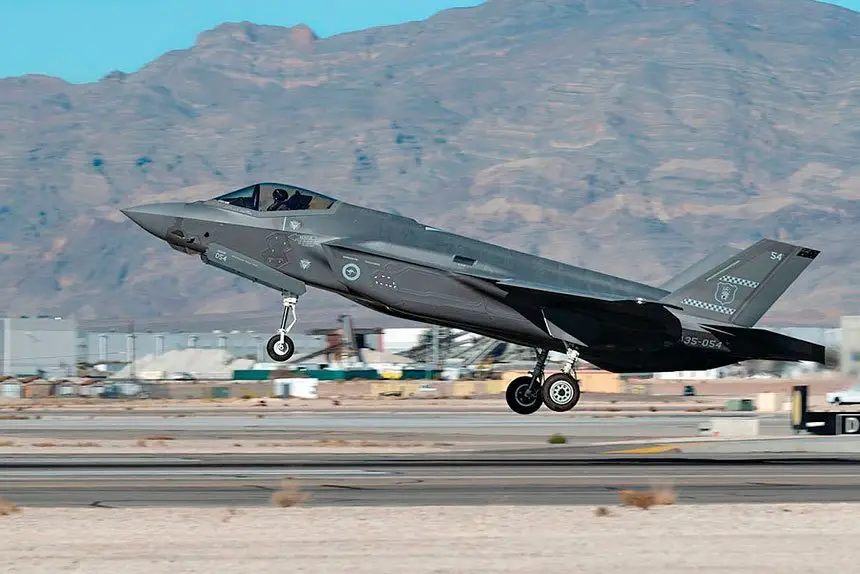
Held from 15 January to 2 February at Nellis Air Force Base in Nevada, USA, the exercise will involve approximately 150 RAAF aviators supporting six F-35A Lightning II aircraft and a tactical command and control team.
Exercise Red Flag Nellis was established in 1975 and recreates the first ten missions of a modern air campaign within a training environment, providing invaluable experience for participants.
Wing Commander Adrian Kiely, Commanding Officer of No. 3 Squadron, said it was the first time Australian F-35As had participated in Exercise Red Flag Nellis.

“Since 1980, generations of RAAF aviators have come to this exercise, which continues to evolve and reflect the threats and challenges faced on modern operations,” Wing Commander Kiely said.
“Missions are conducted to the nearby Nevada Test and Training Range, and further to the southwest of the United States where we can integrate with maritime units.
“Exercise Red Flag Nellis will test every facet of our F-35A capability, allow us to integrate with our American and British allies, and practise how we project force on combat operations.”
Exercise Red Flag Nellis 24-1 will involve approximately 3000 personnel and 100 aircraft conducting large force employment missions in a range of scenarios.
The exercise is renowned for its use of ‘aggressor’ forces, including enemy fighter aircraft, ground-based radars and simulated surface-to-air missiles, as well as cyber and space-based elements that simulate threats for each mission.
Wing Commander Peter Mole, Commanding Officer of No. 114 Mobile Control and Reporting Unit, will lead the RAAF Tactical Command and Control Team in the exercise.
“There is a large number of aircraft, all fulfilling different roles across each mission at Exercise Red Flag Nellis, but no single aircraft is the ‘silver bullet’ that can do it all alone,” Wing Commander Mole said.
“The tactical command and control team’s role is to manage and control all of those aircraft, alongside other elements and units working in the ground, maritime, cyber and space-based domains, to accomplish the mission.
“The scale and complexity of Exercise Red Flag Nellis cannot be replicated elsewhere, which makes it an outstanding place to build experience and reinforce our close working relationship with the United States and United Kingdom.”
FAST FACTS F-35A Lightning II
The F-35A Lightning II is the Australian Defence Force’s first fifth-generation air combat capability. It is a highly advanced multi-role, supersonic, stealth fighter which will meet Australia’s requirements to defeat current and emerging threats.
The F-35A is at the forefront of air combat technology. Advanced sensors and data fusion allow it to gather and share information faster than ever before. Capable of supersonic flight while retaining stealth, the F-35A has extraordinary acceleration, agility and 9G manoeuvrability. The F-35A also provides its pilots with significantly higher levels of lethality and survivability in combat.
The F-35A is characterised by:
- a low observable design
- internal weapons and fuel carriage
- advanced radar
- electro-optical and infrared sensors
- advanced voice and data link communications
- the ability to employ a wide range of air-to-surface and air-to-air weapons.
Australia has committed to 72 F-35A aircraft for three operational squadrons at:
- RAAF Base Williamtown
- RAAF Base Tindal
- a training squadron at RAAF Base Williamtown.
On 17 July 2015, the Department of Environment and Energy published the approval decision for the flying operations of the F-35A after considering the Environmental Impact Statement (EIS).
The first F-35A aircraft was accepted into Australian service in 2018.