
(First published: theconversation.com.au)
“In the United States, we’re taught that nakedness is a very intimate and private thing. Yet, I have to show people my body every day to receive the assistance I need,” writes Ashley Volion, a wheelchair-using disability rights activist, in the book Disability Intimacy.
“I have to be vulnerable in ways that other people wouldn’t even dream of. Intimacy means something deeper.”
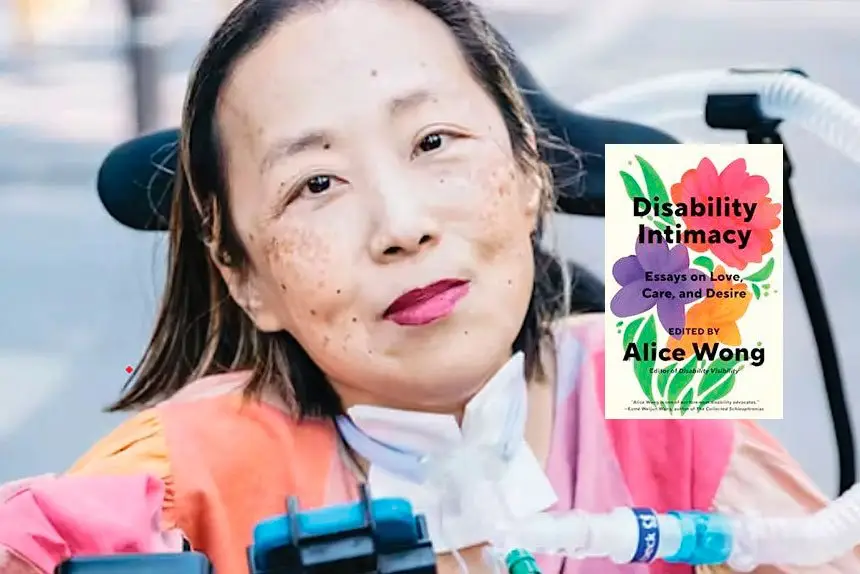
Her contribution is one of many delightful reminders that Alice Wong’s third (and boldest) anthology is anchored in authentic experiences of disabled people and intimacy, rather than stereotypes.

Disabled editor Wong, who won a prestigious MacArthur Foundation genius grant, worth $US800,000, last year, has long been interested in this kind of representation. She has had muscular dystrophy “my entire life” and founded the Disability Visibility project.
An oral history project designed to share the stories of disabled people through interviewing each other, it grew to encompass a podcast, a blog, social media, arts projects, and spaces for connection and community building – and three anthologies of disabled people’s experiences.
Her work centres on disabled people’s perspectives around topics such as opioid addiction, sexual abuse, mental health, economic insecurity, and education.
In a publishing industry where uniformity is emphasised, Disability Intimacy is refreshing. It contains poems, photographic essays (properly described), letters, stories within stories, and many forms of memoir.
They are grouped into four parts: Love and Care, Pleasure and Desire, Creativity and Power, and Everything and Everywhere.
The 40 mostly American writers represent a range of impairments, races, sexualities and genders.
Their ages are less varied. Though most do not mention how old they are, their experiences often span at least four decades. However, in the context of disability, this adds to the anthology’s distinctiveness: we are much less likely than non-disabled people to grow old.
Leah Lakshmi Piepzna-Samarasinha, a nonbinary femme disabled autistic writer, writes:
“You might know a younger crip who was a ball of fire partying it up in the club at twenty-six, but because of the Born to Die Young curse hanging over our heads, you don’t get many pictures of crips in their thirties, forties, fifties, heaven forbid beyond.”
The disability community’s definition of intimacy is not limited to sex. Indeed, sexual pleasure is as important for disabled people as it is for non-disabled people.
Robin Wilson Beattie credits BDSM with teaching her to embrace her disabled body.
“Without BDSM teaching me to embrace my disabled body and feel sexually empowered, I would not be able to connect intimately with others today,” writes Wilson-Beattie, a certified sexual health educator.
However, our definition of intimacy also encompasses the non-sexual.
Contributors write of their intimacy with their children, parents, friends and animals.
Pelenakeke Brown, a Samoan, queer, disabled artist, writes of the intimacy she and other Indigenous women experienced through improvised synchronicity while developing her latest dance show:
“As practising artists, we can spend a lot of time theorising about disability concepts like interdependence, cyborg, and disability aesthetics.
But this moment felt like all those incredibly important concepts came alive in real time, without explanation.”
A number of the pieces explore the many reasons disabled people define intimacy more broadly
than non-disabled people do.
One is that non-disabled people often do not give disabled people the same basic respect they give each other.
“Literally walking the line between able-bodied and not has given me an up-close look at how people think about disabilities,” writer Carrie Wade says, “and I will say this: if you’re not able-bodied, it’s really hard to get people to take you seriously.”