

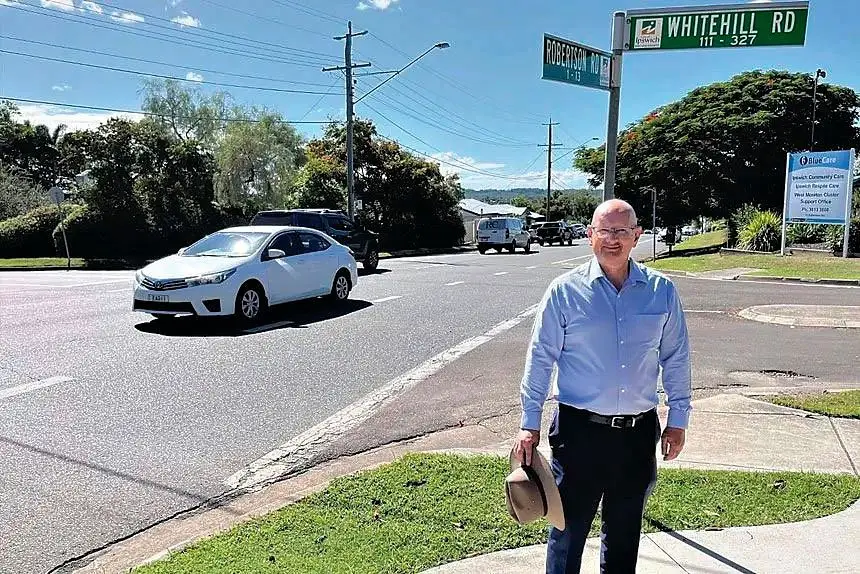
Ipswich City Council has come under fire for a perceived lack of action in addressing dangerous road locations through the federal Black Spot Program.
Federal Member for Blair Shayne Neumann, who has chaired the Queensland Black Spot Consultative Panel since 2022, said the Council’s limited engagement with the program was concerning, especially given the increased funding available.
“Our government recognises that councils need additional support to maintain and repair their local road networks,” Mr Neumann said.
“That’s why the Albanese Government has doubled Roads to Recovery funding – that’s the funding that goes directly to councils from the Federal Government. As part of our commitment to making local roads safer, we’ve also substantially increased Black Spot Program funding, which is progressively rising from $110 million to $150 million per year.”

Mr Neumann highlighted that between 2021 and 2024, Ipswich City Council had nine Black Spot projects approved, receiving a total of $1.84 million.
However, he said more must be done to keep pace with community safety concerns.
“I urge Ipswich City Council to listen to the concerns of our community about the safety of Council-controlled roads and nominate more projects that are deserving of funding,” he said.
Ipswich Infrastructure, Planning and Assets Committee Chairperson Councillor Andrew Antoniolli responded by outlining the Council’s recent efforts.
He confirmed that Ipswich last secured funding for three Black Spot projects in the 2022-2023 round.
These included upgrades at the intersections of Old Logan Rd and Formation St at Carole Park, Gordon St and South St in Ipswich, and Robertson Rd and Whitehill Rd at Eastern Heights.
“A rigorous assessment then follows to determine suitable site improvement options,” Cr Antoniolli said.
“Council is currently in the process of assessing suitable sites for submission under the next round of Black Spot funding, due to be finalised and submitted in the coming weeks.”
However, the Ipswich City Council has not “won funding” for any new Black Spot Program projects in the past two financial years, 2024-25 and 2025-26, or the past two rounds of funding.
Councils, road user groups, and other stakeholders can nominate sites for funding, which are reviewed by a consultative panel made up of representatives from organisations such as RACQ, QPS, the Local Government
Association of Queensland and the Department of Transport and Main Roads.
“The panel provides an opportunity for local stakeholders to have a real say in where funding should be prioritised,” Mr Neumann said. “We rely on councils and the community to highlight the areas that need attention.”
In addition to Black Spot funding, Mr Neumann noted that Ipswich City Council would receive $20.49 million in Roads to Recovery funding over the period 2024-2029.