

Once again, my old Earth book has yielded some wonderful stories about how people got by during hard times.
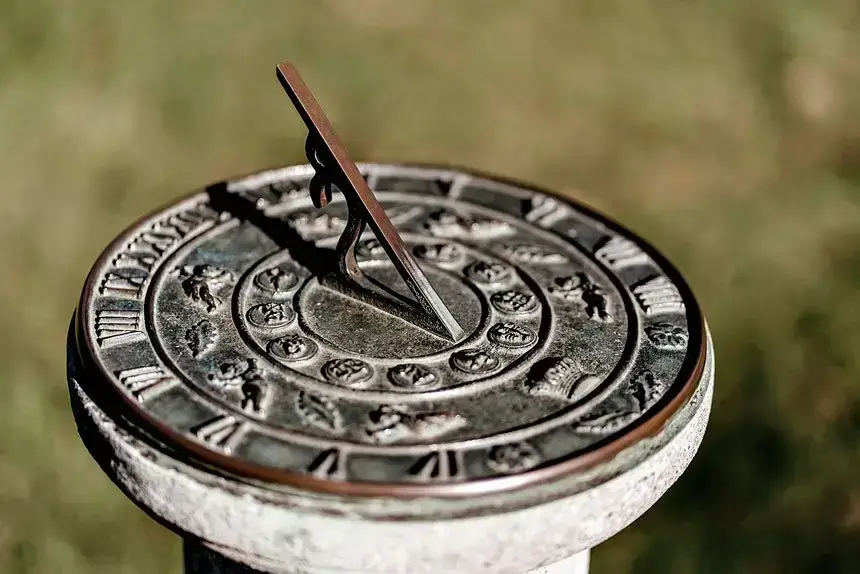
One section describes how to make a sundial – a reminder that the sun was humankind’s first timepiece.
In The Golden Bough, G.S. Frazer writes that Australian Aborigines “used to place stones in trees at different heights to indicate to those following the position of the sun at that particular time of day”.
In very early days, people used sticks, stones, or markings on cave walls to record the passage of days.

The Babylonians are said to be the first to use “units”, dividing the year into 12 months, the week into seven days, and the day into 24 hours. A Babylonian priest is credited with the first sundial.
Sundials soon became the accepted way to tell time. Every medieval church had one, and church clocks were set by them.
A few weeks ago, the Seniors column talked about how many timepieces we have today – so different from the old days when people told time by the stars or the shadow of a sundial.
Even now, you can choose from an incredible range of sundials to match your garden’s theme. They make wonderful conversation pieces – or you might even find a rooster-style sundial that sits on a chook pen and shows which way the wind is blowing.
If you’re handy, you can make your own. All the directions can be found easily from that friendly AI helper on your computer.
Some time ago, the Seniors column also mentioned our internal clock – the “circadian clock” – which regulates many functions in our body, including our sleep/wake cycle and hormone release. When this rhythm is disrupted, it can take time for our bodies to readjust.
Maybe make a sundial a focal point in your garden. Sit it among the flowers and admire the simplicity of its design.
It could even make a perfect Christmas gift – something special for that “hard to buy for” person who’s sure not to have one.
Till next time.