

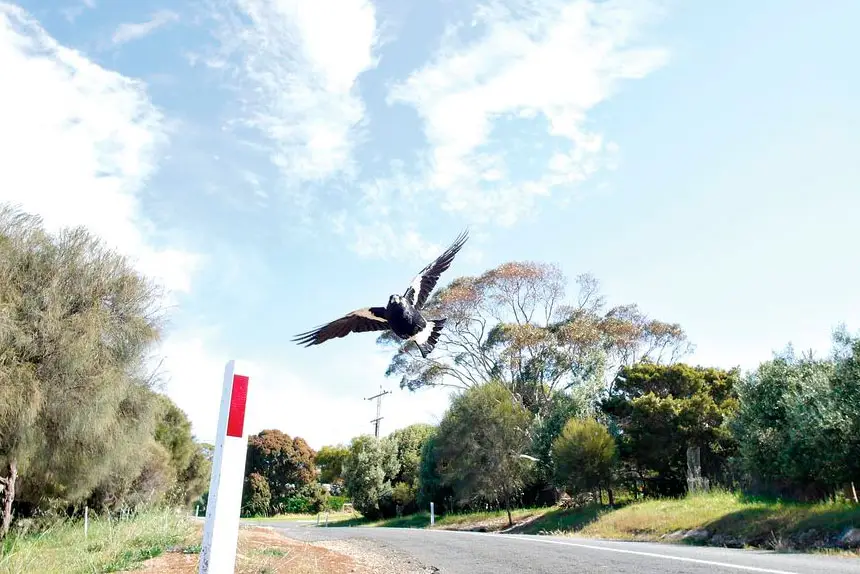
SPRING is breeding season for lots of wildlife, especially birds – so it is also magpie swooping season.
Actually, “magpie season” extends from late August to early December and it’s not just magpies that are the problem.
Other birds that engage in swooping behaviour include magpie-larks (also called peewees), kookaburras, wattlebirds, currawongs, plovers and butcher birds.
The reason why birds swoop at people is to protect their nests, or wherever they have their eggs or hatchlings. They perceive people as a threat. It’s as simple as that.

Some birds, such as plovers, rarely make actual contact with their targets. Others, like the currawongs currently nesting in my backyard, can make contact and even cause injuries.
The first advice is not to become aggressive towards the birds. That can actually make them more aggressive towards you.
Interestingly, birds learn to recognise individual people, so they can act aggressively towards some people and not others.
Birds vary in their nesting habits. Large birds like magpies typically nest in large trees, but in urban environments, they may also use power poles and streetlights as nest sites.
Plovers actually nest on the ground, typically in open grassland or even your lawn.
Hatchlings usually leave the nest after just four or five weeks, so the inconvenience of swooping behaviour is short-lived.
The fact sheet says that if you only notice birds when they swoop, you may have missed the best aspects of birds being in your suburb.
If you have children, a good way to encourage them to appreciate nature is to start a bird list for your house yard.
Our bird list started out with less than 30 species initially, but as we grew more native plants, it increased accordingly.
Today it is over a hundred different species.
If you record the date, season and time of day of each sighting, your bird list can become a valuable ecological record.
If you really need professional assistance for problem birds, you can call your local office of the Queensland Parks and Wildlife Service.
However, only do this as a very last resort.
The QPWS staff who operate the wildlife phone lines typically each receive over a hundred phone calls each day and, each Spring, the phone lines run hot from dawn to dusk.
Stay safe from swooping birds: https://www.qld.gov.au/environment/plants-animals/animals/living-with/swooping.
- Wear a broad-brimmed hat or shelter under an umbrella to protect your face (painting or sticking large “eyes” on the back of your hat can also deter magpies)
- Wear sunglasses to protect your eyes (very important)
- If a magpie swoops while you are cycling, it will often stop swooping if you get off your bike and walk
- Avoid “defence zones” during the breeding season by taking alternative routes
- If you must enter a “defence zone”, magpies will be less likely to swoop if they are watched constantly or if people walk in a close group
- Use signs to warn other people of the location of nests and defence zones
- Wave or hold a stick or umbrella above your head
- Cyclists can fly a brightly coloured flag above their head or attach cable ties to their helmet to discourage birds from swooping
- Don’t approach young magpie or other birds nestlings.