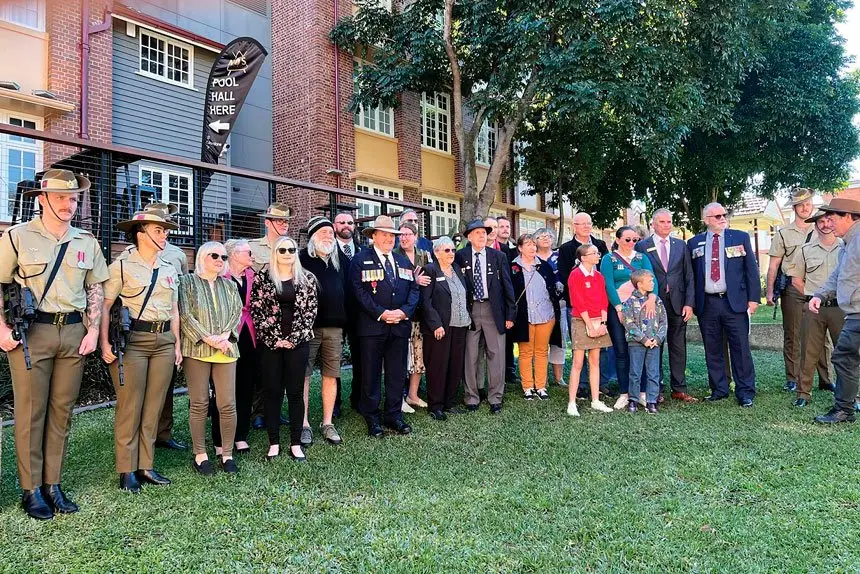
AUSTRALIA’s darkest 24-hour period on the battlefield – the Battle of Fromelles – was solemnly remembered at Ipswich’s Soldiers’ Memorial Hall last Saturday, marking its 109th anniversary.
Ten descendants of the battle’s fallen laid wreaths, including Colonel Mark Plath, Lt Col Russell Linwood and Ann Kirby.
Fought over just 24 hours from July 19 to 20, 1916, the battle claimed more than 5500 Australian casualties –killed, wounded or missing –making it the bloodiest single day in the nation’s military history.
It was Australia’s first major action on the Western Front in World War I and remains one of its most devastating.
Mick James, Secretary of the 31st Infantry Battalion Association (Brisbane Branch), said the battle was long buried in the annals of history due to the scale of the disaster.
“For years, it was seen as an embarrassment,” he said.
“The 1st Division of the AIF, including the 9th Battalion, had conducted a successful trench raid earlier that month and discovered just how strong the German defences were.
“Despite that intelligence, the main assault went ahead – poorly planned and tragically executed. The Germans were ready. They had full visibility of the Australians and had already ranged their artillery. It was devastating.”
Mr James described how the 31st Battalion – comprising two companies from Brisbane and two from Melbourne – had only just arrived at the front with little time to prepare.
General Sir Richard Haking, who led the operation, was later removed from command and never again led troops in battle.
The battle was nearly forgotten until 2008, when a mass grave at Pheasant Wood was uncovered, thanks to the efforts of amateur historian Lambis Englezos.
Between 2009 and 2010, 250 Australian soldiers were exhumed and reburied in the newly built Fromelles (Pheasant Wood) Military Cemetery, with 180 of them identified.