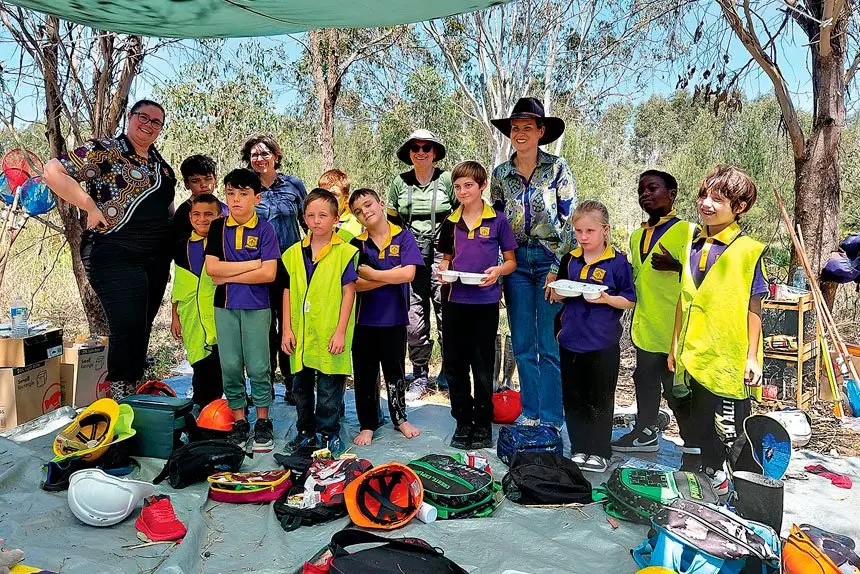
SCIENCE students from Goodna State School were out at Mutdapilly through the week monitoring restored koala habitat through the school’s environmental offset program.
The students were joined by Deputy Mayor Nicole Jonic and koala researcher Rebecca Larkin to highlight the importance of the work carried out through offset programs.
The school’s Mutdapilly Koala Offset program has received handwritten endorsements from Sir David Attenborough, Bob Brown and the CEO of the Australian Conservation Foundation Kelly O’Shanassy.
Goodna State School Principal Nathan Eiby said the Mutdapilly site at G Hines Rd was one of a number of off-campus investigation sites the students accessed.
“Our young scientists have been monitoring the 90ha offset for 10 years and were on hand when the thousands of mostly koala food eucalypts were being planted,” Mr Eiby said.
“This approach takes learning out of the classroom and into the real world.
“Environmental scientists, foresters, ecologists and agricultural scientists have worked with us on site over the years.
“Specialised techniques for planting the seedlings in marginal soil means the plants thrive without any watering after planting.”
The koala offset project is overseen by tennis identity Patrick Rafter’s Cherish the Children foundation and Ipswich City Council.
The school’s senior science teacher Sharon Williams said the investigations students conduct on the site centred on a theme of sustainability.
“The kids compare digital and analogue techniques to measure tree heights, and they also collect data from specific sites using GPS coordinates,” Mrs Williams said.
“This allows them to track growth rates and the condition of the trees over time.
“We have a drone and various apps to help us with this but also use old style analogue technologies like tape measures to gather data as well.”
In 2019, the school won an Advance Queensland grant for $10,000 and bought 10 remote cameras as part of a citizen science project to track the site’s fauna.
The mini-citizen science project engaged more than 600 students in fauna identification at the Mutdapilly offset site using infrared motion sensor cameras and their “Koala capture” website, identifying the presence and grazing habits of koalas, kangaroos, possums, birds, cattle and reptiles along with feral fox and feral pigs, through to the presence of the Giant Wood Moth.
The five-year-old plantings at the Mutdapilly koala offset site showed evidence of koala movement into the area through visual sightings, scat presence and tree scratchings in what was arid grazing land that had been cleared for beef cattle production.
“Differentiation is the key to sustainable futures,” Mrs Williams said.
“Our kids need to understand that environmental problems often need tailored solutions if real change is to be affected over the long term.”