IN the past, spaceflight was the preserve of government-funded astronauts who had to meet stringent physical, cognitive, psychological and social requirements for selection. But in recent years, that has all been changing.
In September 2024, two non-professional astronauts completed the first privately funded spacewalk, using the Crew Dragon spacecraft built by Elon Musk’s company SpaceX.
Meanwhile, Houston-based private company Axiom Space is conducting regular flights to the International Space Station (ISS), carrying a mixture of government-funded astronauts and paying customers.
In the past few years, nearly 100 people have become private astronauts through the space tourism companies Blue Origin, operated by Jeff Bezos and Virgin Galactic, by Sir Richard Branson. While the price of a seat on these vehicles remains out of reach for most of us, prices are expected to drop as more players enter the market.
Despite the rapid growth in the number of space travellers, underrepresented population groups are still left behind, particularly those with disabilities. So how can space agencies and “space tourism” companies make spaceflight more inclusive for disabled astronauts?
The European Space Agency (Esa) recently recruited John McFall, who lost his right leg aged 19, as the world’s first disabled astronaut. McFall, who is a surgeon and former paralympic sprinter, will participate in a feasibility study to improve understanding of, and overcome, the barriers that spaceflight presents for astronauts with physical disabilities.
Esa’s most recent selection of astronauts was entirely of white European background, showing how far things still have to go. But its move to recruit McFall marked a significant milestone towards a more inclusive approach to spaceflight.
The New Shepard vehicle carries paying customers on sub-orbital flights to space.
Designing effective systems for the inclusion of disabled people is a longstanding challenge on Earth – and space presents a whole new paradigm. The very specific demands of spaceflight mean we can’t assume that traditional adjustments and assistive technology will work beyond Earth’s atmosphere. So, making spaceflight more inclusive requires looking at each step of going into space.
Astronaut training is a complex process, designed to simulate the space environment and enable candidates to perform well under a variety of conditions they may encounter in orbit. But in many cases, the training facilities are not well designed for individuals with physical or sensory impairments.
For example, in order to get on the plane that flies in an arc to simulate microgravity (colloquially referred to as the “vomit comet”), astronauts must climb a set of stairs, which presents a hurdle to anyone with a mobility impairment. Ironically, impairments that restrict the use of stairs on Earth might be much less of a restriction once in space.
Spacecraft and space suit design will be another key focus. The space suits onboard the ISS were originally designed with male astronauts in mind, meaning that female astronauts have to “make do” with what is there. This has caused challenges as the number of female astronauts has risen.
In 2019, NASA had to postpone the first all-female spacewalk because the torso of a space suit was too large for one of the spacewalkers. The Moon suit developed by Axiom Space in collaboration with Italian fashion house Prada is a step towards inclusivity, with anthropomorphic sizing to accommodate a wide range of crew members. Yet, future disabled astronauts might still encounter challenges if they have differences in their limbs or impairments to their dexterity.
Interestingly, the new SpaceX Extra Vehicular Activity (EVA) suits have something called “embedded modularity” – each section of the suit is customised to the intended astronaut, and all sections fit together. While intended to help with joint positioning, these suits present a unique opportunity to support disabled astronauts with limb differences.
Inclusive suits could include a single fixed leg portion for individuals with paralysis, and removable parts for those with limb differences. Haptic gloves could provide tactile feedback through the space suit for astronauts with limb differences.
For individuals with visual impairments, incorporating augmented reality (AR) heads-up displays (transparent displays that show the user data overlaid over their environment) and AI-powered image-to-voice software that can translate purely visual information into audio explanations could make a huge difference.
Technological support similar to the app “Be My Eyes”, pairing sighted assistants with visually impaired people to help explain their environment, could also find uses in spacesuits.
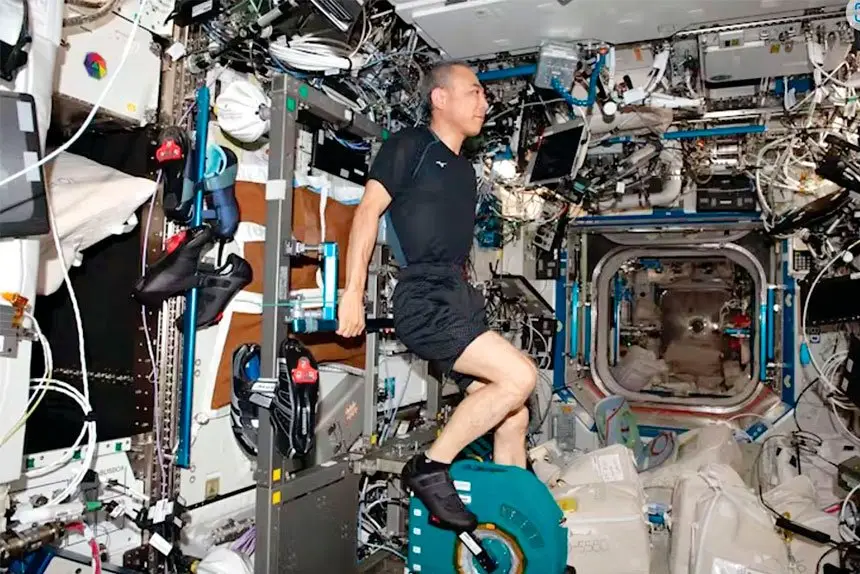
An often overlooked part of astronaut life is maintaining physical fitness through intensive exercise regimes. Exercise is required because both muscle and bone waste away quickly in microgravity – but the fitness equipment aboard the ISS, such as the treadmill and bike, is difficult to adapt for disabled people. Both require use of both feet to operate.
Re-engineering the systems for exercise, eating, working, going to the toilet and other essential activities is critical for enabling disabled astronauts to thrive in space.
Assistive technologies that could be used inside a spacecraft, as opposed to within a spacesuit, are continually evolving and taking many forms. As such, there are always opportunities to improve the environment on a space mission to make it more inclusive for disabled astronauts.
Examples could include virtual reality (VR) for use in ground training, smart prosthetics that enable the completion of complex tasks, and computer vision with AI guiding the visually impaired.
Sean Cullen, lecturer in engineering manufacturing, College of Engineering, Design and Physical Sciences, Brunel University of London; Ezgi Merdin Uygur, lecturer in digital marketing, College of Business, Arts and Social Sciences, Brunel University of London; Vanja Garaj, professor of design and director of research, Brunel University of London. Source: Theconversation.com.au