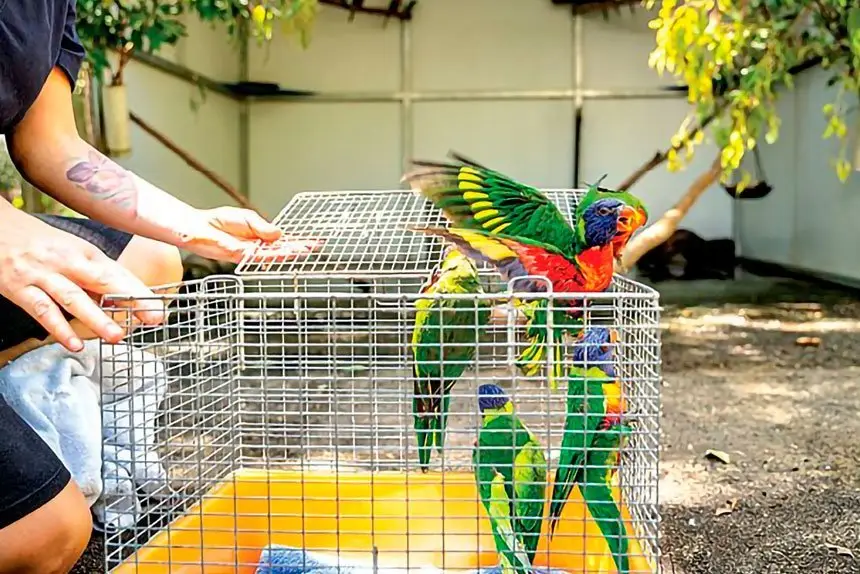
Wild rainbow lorikeets across Ipswich are facing increased incidences of a seasonal disease called Lorikeet Paralysis Syndrome (LPS).
Although the exact cause is currently unknown, LPS causes birds to become paralysed and unable to fly, and occurs more frequently during the summer months.
A spokesperson from RSPCA Qld confirmed there was a spike in cases this year.
“We have been receiving lorikeets from all over Brisbane, but in particular from the Ipswich area,” the spokesperson said.
“We admitted 1,129 [lorikeets] in January, which is several hundred more birds than we would normally see in January.
“Booval is the suburb from which we have seen most birds.”
Symptoms of LPS can include hopping or wobbly movements, voice changes, and an inability to blink or swallow, according to the RSPCA.
If left untreated, the birds are unable to feed themselves and die from dehydration and starvation. “It is treatable when found early, but requires weeks of intensive care for the birds.”
By the end of last week, the Wacol-based hospital had more than 100 lorikeets in its care. “We have increased the resources available to manage the number of incoming birds, but this situation is a significant increase in our workload.
“We are well over our normal capacity to respond but are managing for the moment.”
According to Wildlife Health Australia, there is no indication that LPS can be transmitted to humans, pets, or other species of birds.
Certain plants containing toxins, such as those used for landscaping, may be responsible.
Any ill lorikeets exhibiting symptoms should be brought to the RSPCA or a local veterinary clinic. You can also call the RSPCA’s 24/7 Animal Emergency Hotline on 1300 ANIMAL (1300 264 625) or your nearest wildlife carer. Residents should not touch dead birds.
Luise Manning, president of Springfield Lakes Nature Care, said the best way to handle a distressed bird is to wrap it gently with a towel or clothing item to avoid scratches, then place in a shoe box or other small cardboard container punctured with holes, and a lid secured with a rubber band for transportation.