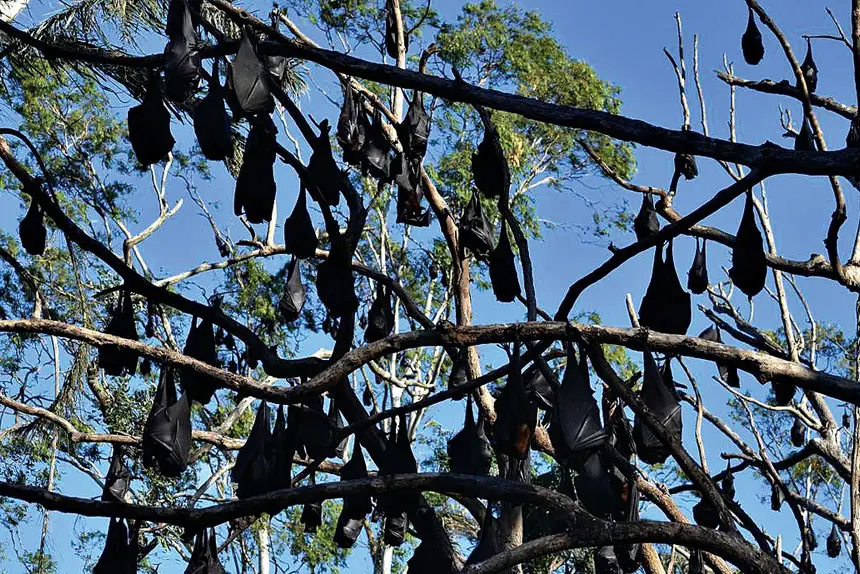
THE flying-fox roost at Nerima Gardens in Ipswich’s Queens Park continues to be closely monitored by Ipswich City Council, as sections of the Japanese-inspired gardens remain closed to the public.
The colony, home to black, grey-headed, and seasonal little red flying-foxes, plays a crucial role in the region’s ecosystems, dispersing seeds, pollinating native plants, and supporting forest diversity.
Council officers manage the site carefully to protect both residents and the animals, a task made even more significant by recent State policy changes that have rolled back plans to phase out lethal control permits.
The roost has called Nerima Gardens home since 2013, with Council actively managing the site under legislation that protects flying-foxes and recognises their critical ecological role.
Council officers keep sections of the gardens closed as a precaution to ensure public safety while the roost remains active.
“Flying-foxes are a protected native species and play an important role in the local ecosystem,” said Environment and Sustainability Committee Chairperson Jim Madden.
“At Nerima Gardens, black and grey-headed flying-foxes are present year-round, while little red flying-foxes generally arrive from late spring through early autumn. Council continues to manage the roost in line with legislation and best-practice management.”
For some residents, however, the closures have changed the way they experience one of Ipswich’s most cherished public spaces.
“I love Queens Park, but the smell and noise can be overwhelming at times,” Silkstone local Samanta Colman said.
“I understand they’re protected, but it does make that part of the park less enjoyable, especially with young kids.”
Wildlife expert Meg Edwards, Senior Lecturer of Wildlife Sciences at UniSQ, said the ecological importance of flying-foxes was pivotal.
“All species in Australia are protected. The grey-headed flying-fox, for example, is considered vulnerable nationally.
“Protecting all flying-fox species is crucial – they disperse fruit, seeds, plant matter, and pollen, ensuring the health and diversity of our forests and crops.”
Dr Edwards added that public education was a key part of co-existing with flying-foxes.
“Most interactions are harmless – they’re more afraid of us than we are of them,” she said.
“Non-lethal strategies, like shelters over walkways or netting in agricultural areas, are far better than shooting.
“Flying-foxes maintain ecosystem balance – without them, forests and food systems suffer.”
Division 3 Councillor Marnie Doyle explained that Council’s approach is guided by a formal framework designed to balance environmental responsibility with community safety.
While Council continues to manage the Nerima Gardens colony, recent changes at the State level have sparked concern.
The RSPCA Queensland reported that flying-fox protections have been rolled back, allowing permits to shoot them to continue – a reversal of plans to phase out lethal control by mid-2026.
Conservation and animal welfare groups have launched a Queensland Parliament petition calling for the phase-out to be reinstated.