TEN years ago, feral camels were seen as little more than a dusty outback headache.
But while others talked control and culls, Scenic Rim entrepreneur Paul Martin was thinking big – very big.
He saw “white gold”.
“We’re not just exporting milk – we’re changing how the world sees the Australian camel,” Mr Martin said.
“In the Middle East and Africa, camels are prized. Here, they’ve been treated as a problem.
“We’re turning a liability into a premium global asset.”
Now, that bold vision has paid off.
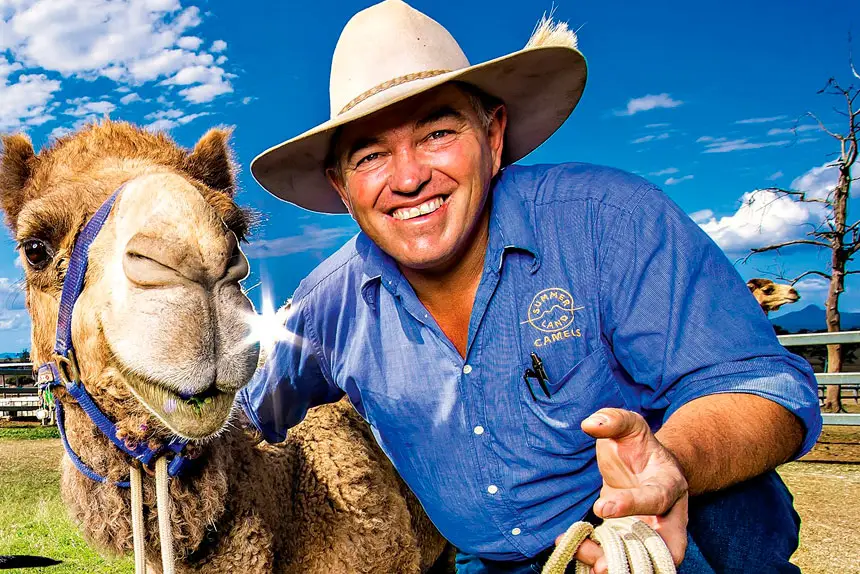
Local tourism drawcard Summer Land Camels has secured a landmark deal to export Australian camel milk to the US, locking in orders of up to 60,000 litres a year.
It’s a historic first – the first time Australian camel milk will hit the US market at large commercial scale – and it puts the Scenic Rim on the map as the unlikely launchpad for one of the world’s hottest new health food trends.
“We have spent a decade building the herd, proving the science, winning the awards and validating the market,” Mr Martin said.
“Now the opportunity is here to take an Australian success story and scale it for the world.”
The breakthrough comes after 10 years of steady growth that has transformed a bold sustainability idea into a globally competitive agri-business.
By harnessing Australia’s unique disease-free camel herd, the company has built what industry insiders now describe as a biological monopoly, with no other country able to supply large volumes of premium camel milk with the same health and biosecurity credentials.
Over the past two years, sales of camel milk powder – one of the world’s most valuable functional food ingredients – have surged 128 per cent, including a 76 per cent rise in the past year alone.
Fresh camel milk sales have grown 120 per cent over the same period, reflecting a shift as health-conscious consumers move beyond plant-based alternatives and seek naturally functional dairy products.
Summer Land Camels has also collected more than 100 dairy awards and established a national skincare line made from camel milk, while its farm now attracts close to 70,000 visitors a year as one of the region’s leading agri-tourism destinations.
The timing of the US expansion aligns with explosive global demand for gut-health products, low-allergen dairy and functional nutrition.
Camel milk, which is naturally rich in A2 proteins, immune-supporting compounds and easier to digest than cow’s milk, has become one of the most sought-after alternative dairies in the world.