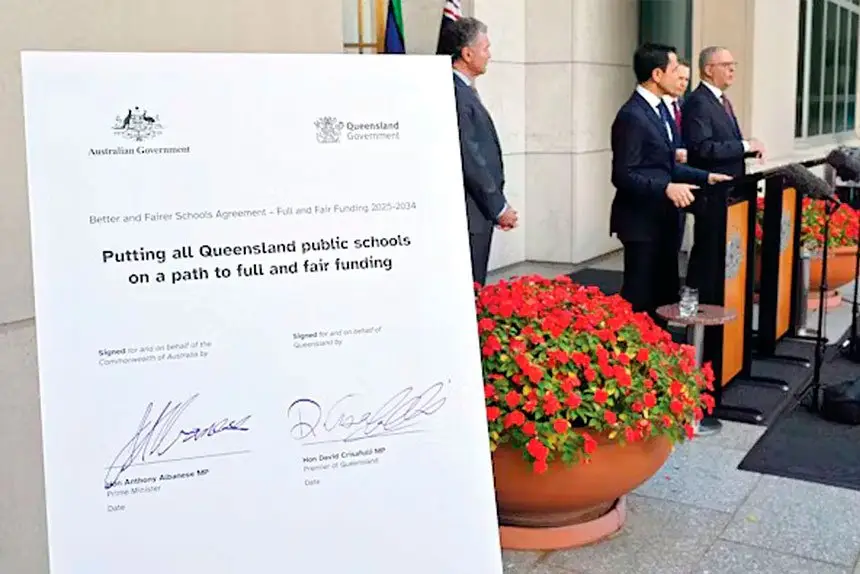
AUSTRALIAN states and territories have officially signed onto a new national school funding agreement, paving the way for major reforms in classrooms and a commitment to fully fund public schools by 2034.
The landmark deal follows more than a year of negotiations between the Federal and State Governments.
It signals a key shift in funding responsibilities and education policy, with the Federal Government increasing its share of public school funding from 20 to 25 per cent.
In what’s being hailed as a major win for public education, the agreement guarantees schools will receive 100 per cent of the funding recommended by the Schooling Resource Standard (SRS) within the next decade.
The agreement also ties government funding to specific reforms, aiming to boost student outcomes and modernise how schools are supported and assessed.
Among the most significant changes is the introduction of a Unique Student Identifier (USI) for every child from the moment they start school.
The identifier, already in place for university and vocational education students, will track a student’s learning journey from early education through to tertiary study or training.
Education experts say the USI will provide crucial insights into student progress and help governments understand how young Australians transition through the different stages of education.
Another key reform is the rollout of a national phonics check for Year 1 students, alongside a new early-years numeracy check.
Unlike NAPLAN, which begins in Year 3, the new assessments are designed to offer diagnostic information at an earlier stage – helping to identify students and schools in need of extra support.
The agreement also outlines two major reviews.
The first will re-examine the current school funding model – the first time since the SRS system was introduced in 2011.
The second review will focus on the National Measurement Framework for Schooling, which monitors key performance indicators such as NAPLAN results, attendance rates and school completion.