A CUTTING-EDGE research mission led by the University of Southern Queensland has provided critical data on atmospheric re-entry, enhancing global understanding of space technology and debris management.
Under the leadership of Fabian Zander, UniSQ’s expert team successfully captured the re-entry of Varda Space Industries’ W-2 hypersonic capsule and its parent spacecraft over South Australia.
The capsule, which had spent 45 days in orbit, marked a major milestone for space science.
The mission was conducted in collaboration with Southern Launch, which managed the re-entry and recovery, and Varda Space Industries, based in El Segundo, California.
UniSQ played a key role in gathering high-precision tracking data, which is critical for developing predictive models that improve spacecraft design and safety protocols.
“We were able to validate and refine the scientific models that predict how spacecraft and space debris behave when re-entering Earth’s atmosphere,” Associate Professor Zander said.
“Our research is vital for developing safer, more efficient space technologies, and contributes to global efforts to manage space debris.”
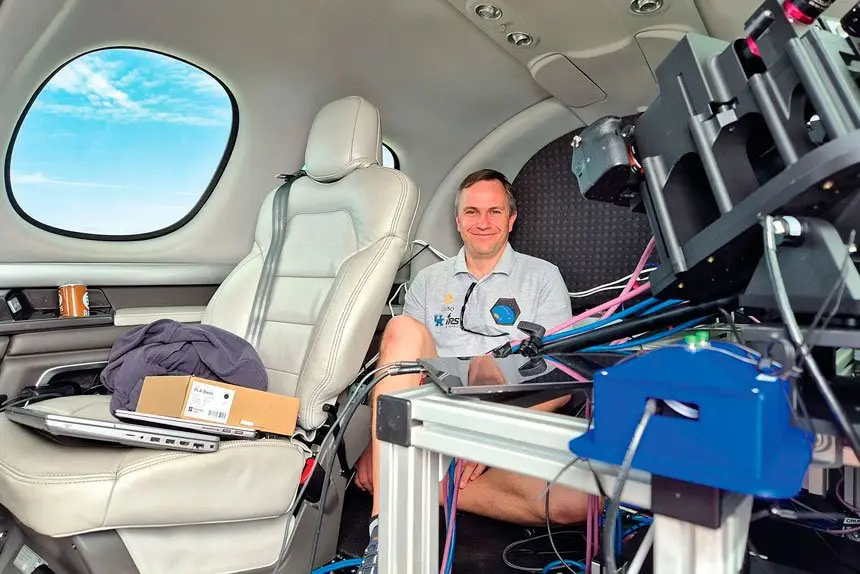
UniSQ deployed both airborne and ground-based observation teams to monitor the re-entry event.
The ground-based team, led by Andrew Lock, positioned observation stations 125km apart in South Australia.
“This mission provided us with a rare opportunity to enhance our understanding of re-entry dynamics,” Dr Lock said. “The data we’ve gathered will contribute to improving spacecraft design and safety measures.”
As part of its broader research initiative, UniSQ continues to lead studies on high-speed atmospheric events, including controlled and uncontrolled space debris re-entries, hypersonic test vehicle flights, and rocket launches.