
AS Queensland Dinosaur Week 2026 prepares to showcase the State’s rich prehistoric past, attention is turning to an unlikely starting point for Australia’s dinosaur story – beneath the suburbs of Ipswich.
Ipswich today offers few clues to its ancient origins, but more than 220 million years ago, the region was a swampy landscape where some of Australia’s earliest dinosaurs left their mark – literally.
That mark was discovered in the mid-1960s, when miners working deep underground at the Rhondda Colliery in New Chum uncovered a series of large, three-toed footprints preserved in the rock above a coal seam.
Formed in soft mud during the Late Triassic and buried over time, the tracks were remarkably well preserved, appearing as though a dinosaur had just passed overhead.

For decades, scientists believed the footprints were made by a large carnivorous dinosaur. Early size estimates suggested a formidable trackmaker, comparable to later predators such as Allosaurus or even Tyrannosaurus rex.
However, the age of the tracks, dating back around 220 million years, raised questions, as large theropods are not known to have existed at that time.
Now, new research is changing that understanding.
In a study led by Anthony Romilio and published in Historical Biology, scientists have reanalysed the Ipswich tracks using modern digital techniques.
With the original site no longer accessible, the team examined archival photographs and a plaster cast held at the Queensland Museum, creating a detailed 3D model of the footprint.
The results reveal the tracks were smaller than originally thought, closer to 32 to 34 centimetres, and, more importantly, that they were not made by a predator at all.
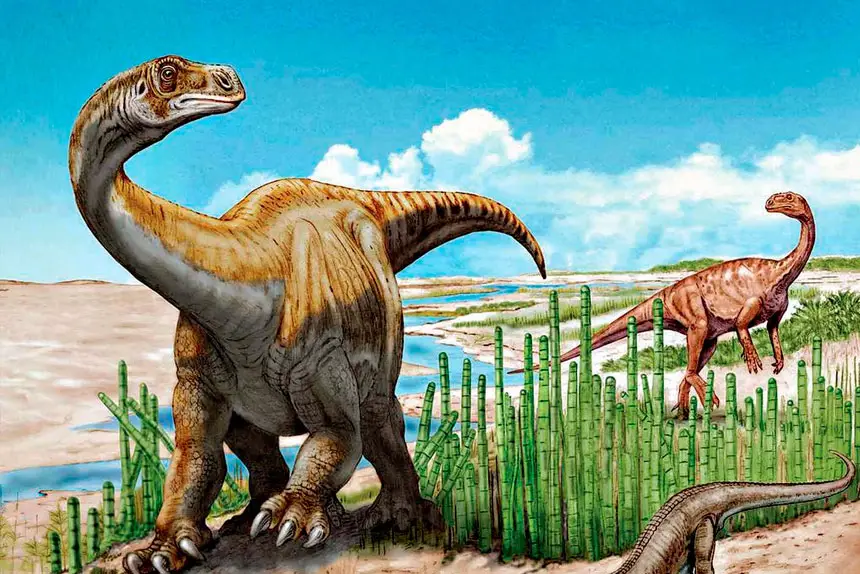
Instead, the footprints belong to an early sauropodomorph, a plant-eating dinosaur and distant relative of the long-necked giants that would later dominate the Jurassic and Cretaceous periods.
The discovery marks the first recognised evidence of basal sauropodomorphs in Australia and aligns the country with similar fossil records found across South America, Africa and Europe.
At the time these dinosaurs roamed, the continents were still joined as part of Pangaea, allowing species to spread across vast, connected landmasses. During this Late Triassic period, dinosaurs were only beginning to emerge and had not yet become the dominant land animals.
Ipswich’s contribution to this story is closely tied to its coal mining heritage.
Suburbs including Ebbw Vale, New Chum and Swanbank were once hubs of underground mining, where shafts extended hundreds of metres below the surface.
These operations, active from the late 19th century through to the late 20th century, inadvertently exposed fossil evidence that has since proven critical to understanding Australia’s prehistoric past.
As Queensland Dinosaur Week invites visitors to explore the State’s ancient past, Ipswich stands as a reminder that some of the most important discoveries aren’t always the most obvious.
This is helping scientists rewrite the story of dinosaurs first emergong in Australia.