

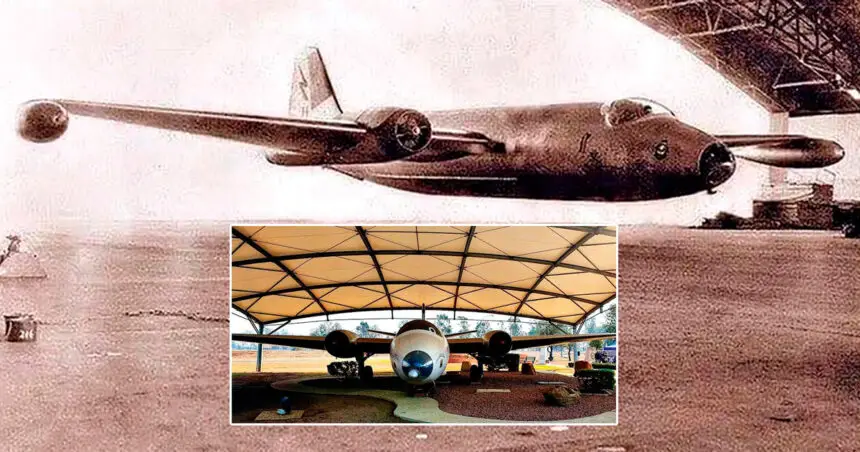
THERE is a man lying flat on the floor of an Amberley hangar and, apparently, several tonnes of Canberra bomber are about to pass inches above his head.
Its wheels are up, its wings stretch across the building and the aircraft appears to be airborne, leaving the unfortunate airman underneath hugging the concrete as though he has chosen possibly the worst place imaginable to spend his afternoon.
It is one of Australian military aviation’s great photographs and, if the story that followed it around the world is to be believed, evidence of one of the most spectacularly questionable pieces of flying in RAAF history.
However, the Canberra never flew through the hangar, but the photograph was so convincing that the story certainly did.

For decades, the extraordinary image from RAAF Base Amberley has been passed between aviation enthusiasts, veterans and history buffs, gathering new details with almost every retelling.
One popular version dates the prank to 1955 and credits bored National Service airmen. According to the yarn, they placed the Canberra on maintenance stands, retracted its landing gear, convinced one man to lie underneath pretending his final moments had arrived and then used old-fashioned darkroom trickery to remove the supports from the finished photograph.
It is a magnificent military yarn, but it is also where history and folklore begin to part company.
What can be established is the identity of the aircraft, which has been identified as GAF Canberra Mk.20 A84-216, one of 48 Australian Canberras manufactured under licence by Government Aircraft Factories.
Amberley became one of the Canberra’s great Australian homes, with No. 82 Wing operating the bombers from the Queensland base as the jet became an important part of the RAAF’s frontline force. A84-216 made its first flight on March 15, 1955 and was delivered to the RAAF on April 4, firmly connecting the aircraft with 1955 but not necessarily the famous photograph.
Surviving attribution associated with the image instead places A84-216 at Amberley around 1970, raising serious doubts about the oft-repeated story that National Servicemen created it in 1955.
Somewhere during decades of retelling, it appears the aircraft’s 1955 origins may have become tangled with the circumstances surrounding the photograph itself.
Tracing the image back through Australian Canberra records returned the aircraft to its proper identity as A84-216 at Amberley, but by then the real bomber was long gone.
Its disposal was approved on November 19, 1971 before it was sold to Hookway Aviation in April 1972, transported by road to Morwell in Victoria and eventually scrapped.
A84-216 may never have flown through that Amberley hangar, but more than half a century later, its legend is still flying.