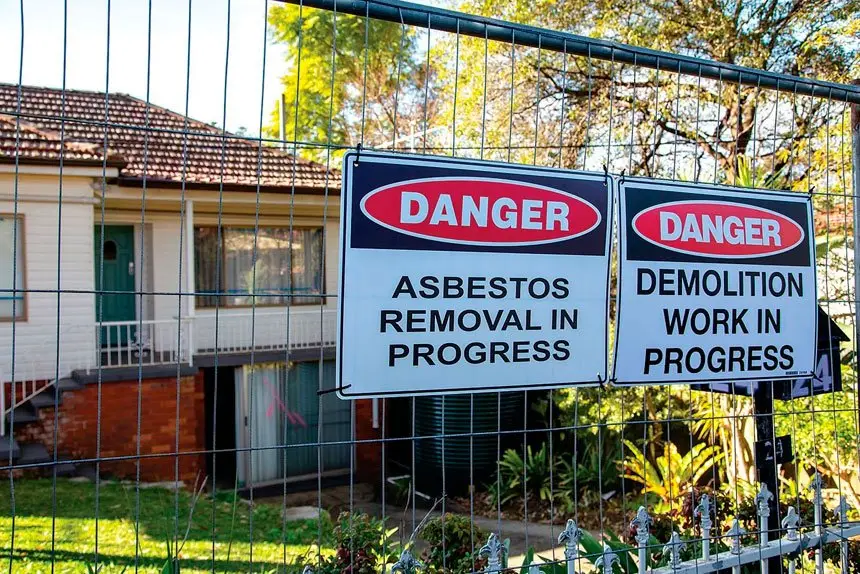
WITH asbestos-related deaths surpassing the annual road toll, people are being urged to be aware of potential dangers.
Asbestos is lurking within one-in-three Australian homes, so it is vital Australians can identify and manage asbestos safely.
If sealed and in good, stable condition, asbestos-containing materials don’t pose a health risk.
However, when disturbed during demolition, renovation or maintenance when microscopic fibres are released, this can lead to life-threatening diseases including malignant mesothelioma, asbestosis and lung cancer, while evidence suggests links to ovarian and laryngeal cancers and increased risk of breast, stomach and colon cancers.
Clare Collins, chair of Advocacy Australia and the Asbestos Education Committee said: “Every year, asbestos kills around 4000 Australians – that’s more than double the national road toll.
“With no known safe level of exposure to asbestos fibres, the only way to prevent asbestos-related deaths is to increase awareness of the risks of disturbing asbestos during home renovations, demolition or maintenance and providing education tools and information about asbestos locations and how to manage it safely,” she said.
This year, the Asbestos Education Committee has announced its new user-friendly asbestos education tool to ensure property owners and tradies identify and remove asbestos-containing materials safely in accordance with regulations.
“In our new, 20-minute real-life, step-by-step video, Asbestos in Homes: A Guide to Identification, Testing and Removal we discuss asbestos safety, the legalities and the simple steps people should take for asbestos inspections and removal so they know how to protect themselves, their families, tradies and anyone who might risk exposure to asbestos fibres during renovation, demolition or maintenance,” Ms Collins said.
Asbestos in Homes: A Guide to Identification, Testing and Removal features industry leaders including Cherie Barber, Australia’s Renovation Queen with members of the Asbestos Education Committee; Bret Baker, President of the Asbestos & Hazmat Removal Contractors Association of NSW (AHRCA); John Batty, President of the Asbestos & Hazardous-Materials Consultants Association (AHCA); and Mathew Klintfält who continues the work of his late mother Carol Klintfält OAM in asbestos awareness advocacy.
Cherie Barber, asbestos awareness ambassador who lost her grandfather to an asbestos-related disease said:
“Because Australia was one of the highest consumers of asbestos-containing materials globally, the importance of continuing to increase awareness and providing practical resources that build community knowledge on identifying and managing asbestos safely, cannot be overstated,” she said.
“Most Australians don’t know that asbestos was not only used in the construction of fibro homes, but it was also used extensively in the manufacture of more than 3000 building and decorator products that could be lurking in any brick, fibro, weatherboard, clad home or apartment built or renovated before 1990.
“Asbestos could be under floor coverings including carpets, linoleum and vinyl tiles.
“It could be behind wall and floor tiles, in cement floors, internal and external walls, ceilings and ceiling space (insulation), eaves, roofs, around hot water pipes, fences, home extensions –it was used everywhere.”