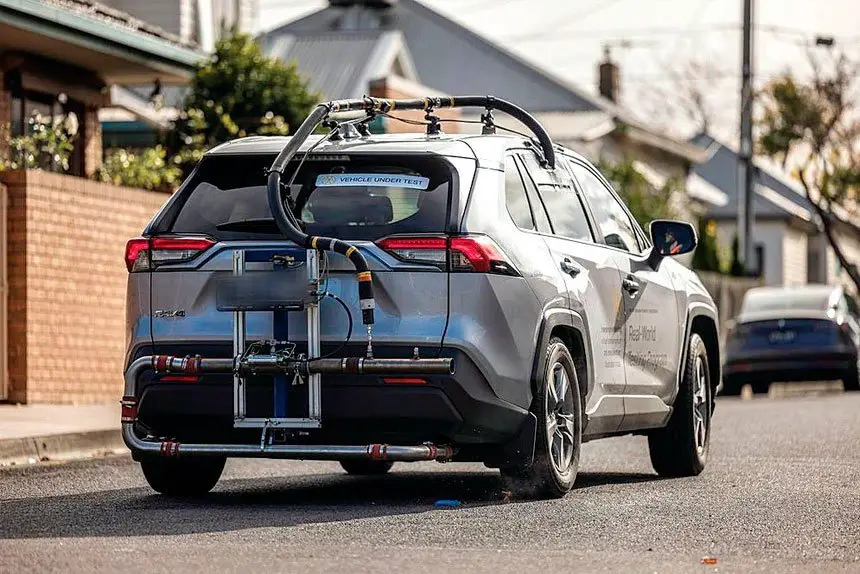
The Real World Testing program has been developed in conjunction with the Australian Commonwealth Government, whereby vehicles are tested against the same testing protocol for consistency and transparency.
Nine SUVs were tested by the Australian Automobile Association (AAA) to see how closely their manufacturer’s lab results matched their fuel efficiency and emissions performance on real Australia roads, in real Australian conditions.
RACQ Principal Technical Researcher Andrew Kirk, who sat on the AAA’s Real World Testing advisory panel, said the first round of results produced some discrepancies.
“The 2022 Hyundai Kona and 2022 Toyota RAV4 both recorded 13% more fuel usage on the road than they did in a laboratory test,” Mr Kirk said.
“The 2022 Ford Puma and 2023 MG ZS used 8% more fuel on Australian roads in comparison to their manufacturer’s lab tests, but interestingly, the 2023 Nissan X-Trail and 2023 GWM Haval Jolion recorded lower fuel consumption than in their laboratory tests.
“RACQ is proud to support the AAA’s program because buying a new car is a huge investment and motorists deserve to know how their vehicle performs right here in Australia.
“If a car you’re interested in will use more fuel in the real-world compared to its reported lab results, that could affect your hip pocket for years to come.”
The Real World Testing program will empower Queensland motorists to make more informed decisions when buying their next car, using real-world running costs and real-world emissions, rather than figures recorded in aindoor lab overseas.
The results also revealed seven SUVs recorded higher emissions on the road than in a lab setting.
The $14 million federally funded program is set to test around 200 new cars, utes and vans over the next four years. – RACQ