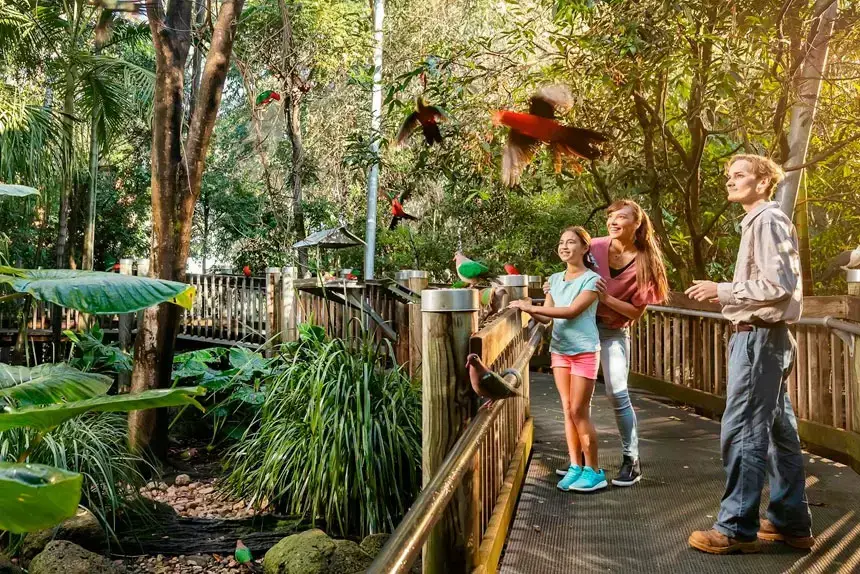
LAUGHTER, curiosity and wide-eyed wonder continue to fill the pathways of the Ipswich Nature Centre, with more than 160,000 visitors passing through the gates each year to experience one of the city’s most cherished attractions.
For generations of Ipswich families, the Nature Centre in Queens Park has been a rite of passage. It is where children come face-to-face with rock wallabies, pause quietly beside sleepy dingoes, and begin to understand that Australia’s wildlife is something to be respected and protected.
“It’s one of the few places where the kids can really slow down, look closely and ask questions,” Bundamba mum of two Zoe Cochrane said.
Ipswich City Council says strong visitation, continued investment and a long-term focus on animal welfare underpin the centre’s ongoing success.
While recent public discussion and local media reporting highlighted isolated individual concerns, a Council spokesperson said the broader picture showed a much-loved facility supported by sustained funding and careful planning.
“Council is proud of the Ipswich Nature Centre and the important role it plays for locals and visitors alike,” the spokesperson said.
“It offers the chance to encounter iconic native animals, and remains a key attraction for the city.”
The centre is home to more than 45 animal species and plays a vital dual role as both an educational resource and a tourism drawcard.
University of Southern Queensland wildlife science senior lecturer Meg Edwards said the centre offered learning experiences that could not be replicated in a lecture theatre.
“Seeing animal husbandry and welfare practices in action helps connect theory with real-world application, and the staff are incredibly generous with their time and knowledge,” Dr Edwards said.
She said early exposure to wildlife was just as important for younger visitors, helping shape long-term attitudes toward conservation.
“There’s a lot of research showing people need to know about something before they can care about it,” she said.
“Facilities like the Ipswich Nature Centre allow children – and adults – to get close to species they might never otherwise encounter.”
The centre’s nocturnal house, featuring animals such as bilbies and hopping mice, is a standout example.
“You’d almost never see these animals in the wild,” Dr Edwards said. “The lighting allows people to observe natural behaviours that usually happen while we’re asleep.”
Public debate around vacant enclosures, she said, often overlooked the reality that animal welfare must always come first.
“Animals may be moved between facilities as part of nationally coordinated breeding programs to maintain genetic diversity, or exhibits may remain empty while the right long-term decision is made,” she said.
Looking ahead, Council has committed $3.9 million over two years in its 2025-26 Budget to support essential upgrades.
Staffing stability has also been strengthened, with two casual roles transitioned into permanent positions to support continuity of care.
Over the past year, several animals have died from natural causes, including much-loved Dexter the bull. Council said these losses, combined with maintenance and welfare considerations, had temporarily reduced enclosure occupancy, with two of the centre’s 23 enclosures vacant as of mid-January.
“Replacing animals is a complex process,” the spokesperson said.
“Every decision is guided by animal welfare, conservation outcomes and educational value.”
As the only free zoo in South East Queensland, Dr Edwards said the Ipswich Nature Centre held a unique place in the region’s cultural and educational landscape.
“It would be a huge loss if it didn’t exist — not just for Ipswich, but for the wider community,” she said.