
GOVERNMENT investment in preparing for H5 bird flu dwarfs the funding allocated for Queensland’s varroa mite response, as beekeepers’ struggles with the parasite continue to cripple their industry.
The Australian Government is investing $270 million in the national H5 bird flu response, while Queensland has committed just $5.5 million over three years until mid-2027 to support the collective management of varroa destructor.
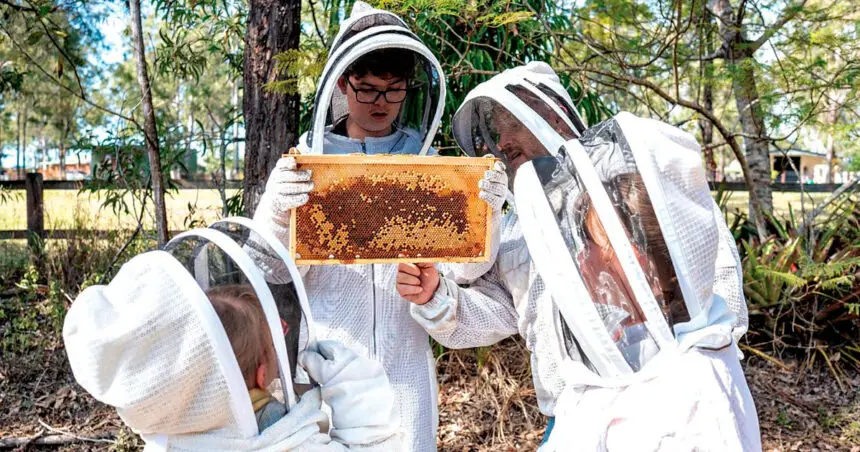
For Bee All Natural owner and Flagstone-based local beekeeper Jason Roebig, inset below, the cost can be counted in hundreds of lost hives, thousands of dollars and more than a decade of work devastated.
His family business entered the crisis with 450 hives and at its lowest point only 95 remained, with Mr Roebig estimating the lost colonies amounted to $159,750, before accounting for reduced honey production, treatments, additional labour and rebuilding costs.

“There is also an emotional cost that doesn’t appear on a balance sheet,” he said.
“These colonies represent more than a decade of hard work building a family business.”
A Queensland Department of Primary Industries spokesperson said $500,000 had been provided through the Community Bee Innovation Fund in 2025-26, supporting 16 active projects to help beekeepers adapt.
“While funding announcements are welcome, there is a significant difference between money being allocated to programs and meaningful assistance reaching beekeepers who are struggling to keep their businesses operating,” Mr Roebig said.
“In short, we have received no direct financial support from either the State or Federal Government.”
In a good year, Bee All Natural would produce 10 to 15 tonnes of honey, wholesaling at $4.50 a kilogram, representing between $45,000 and $67,500 in revenue before expenses.
“The reality is that we are spending considerably more to produce substantially less,” Mr Roebig said.
Meanwhile, Queensland is strengthening its H5 bird flu response capability through $2.12 million in Australian Government funding, supported by state in-kind contributions and ongoing investment.
The State Government has separately set aside $9 million across 2026-27 to 2028-29 to support a response to any bird flu outbreak.
“I struggle to understand why there is such a significant difference in funding when varroa is already having such a widespread impact on our beekeeping industry and the growers who depend on us,” Mr Roebig said.
He questioned whether funding was being fairly distributed under the Department’s “shared responsibility” approach.
“It feels as though shared responsibility means beekeepers carry the financial risk, absorb the losses and find their own way to recover,” he said.
He urged consumers to buy directly from local producers, and always choose Australian honey.
He also invited the relevant polititians to visit his apiary.
“Before making decisions about the future of our industry, come and stand beside the people whose livelihoods depend on it,” he said.