

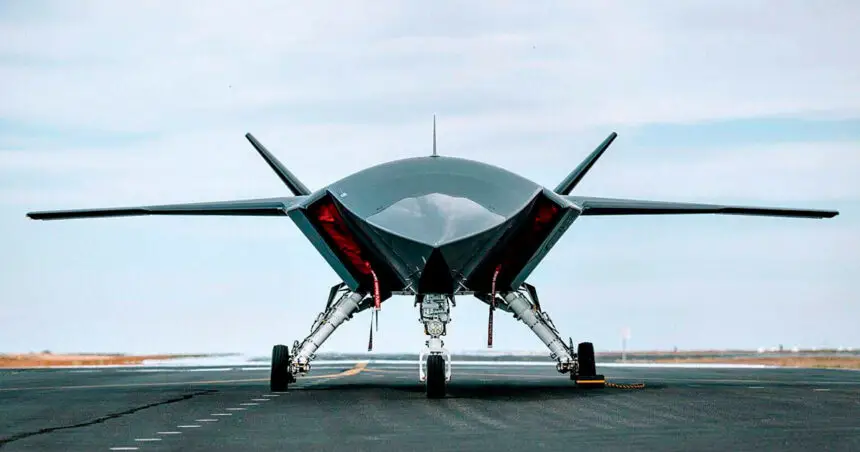
THERE is something unsettling about an aircraft you might never hear coming, whose movements you cannot easily track, and whose most advanced capabilities remain beyond public view.
For residents of Ipswich and the surrounding suburbs, the idea of a mysterious aircraft operating overhead sounds like the stuff of conspiracy theories or supernatural folklore.
Yet behind the whispers of “ghost planes” lies a very real piece of Australian military technology: the MQ-28A Ghost Bat.
Developed by Boeing Australia in partnership with the Royal Australian Air Force (RAAF), the Ghost Bat represents a new frontier in military aviation. It is an uncrewed combat aircraft designed to operate alongside conventional fighter jets, combining autonomous systems, sophisticated sensors and a low-observable design intended to reduce its radar signature.

A GHOST WITH A REAL-WORLD IDENTITY
The name Ghost Bat is inspired by Australia’s native ghost bat, a nocturnal creature known for navigating and hunting in darkness.
It is an evocative name for an aircraft designed to operate in some of the most demanding environments modern air warfare can present.
Unlike a conventional fighter, the MQ-28A has no pilot in its cockpit. Instead, it uses onboard mission systems to carry out assigned tasks and work in coordination with crewed aircraft.
The concept is part of a broader military shift towards collaborative combat aircraft, sometimes described as “loyal wingmen”.
These uncrewed aircraft could support fighter pilots by gathering information, extending sensor coverage, carrying additional equipment or undertaking dangerous missions that would otherwise expose human aircrews to greater risk.
WHY AMBERLEY ADDS TO THE INTRIGUE
The connection between the Ghost Bat and RAAF Amberley is more than geographical, with the aircraft officially named at Amberley in March 2022, and the base has featured in subsequent public announcements about the program.
The Ghost Bat’s existence, development and certain test activities are publicly documented.
However, the fact that it is associated with Amberley does not establish that any particular unidentified aircraft seen over Ipswich is a Ghost Bat nor does it prove that secret patrols are taking place over residential areas.
STEALTH, AUTONOMY AND THE LIMITS OF WHAT WE KNOW
Part of the Ghost Bat’s mystique comes from the technologies it brings together.
Its low-observable design is intended to make it more difficult for adversaries to detect and track using radar.
But stealth does not mean invisibility. Detection depends on many factors, including the sensor being used, the aircraft’s position and the surrounding environment.
Its autonomous mission systems are equally intriguing. The aircraft is designed to execute assigned tasks and coordinate with other platforms, potentially allowing one human operator to supervise multiple uncrewed aircraft.
Public demonstrations have shown Ghost Bats operating in conjunction with an E-7A Wedgetail airborne early-warning aircraft and an F/A-18F Super Hornet. These trials illustrate a future in which combat aircraft may function as part of a connected network rather than operating as isolated platforms.
Yet there is an important difference between sophisticated autonomy and an aircraft operating entirely independently of human oversight.
The full architecture of the Ghost Bat’s mission software, its precise operational limitations and many details of its intended employment are not publicly available.
That gap between what is known and what remains undisclosed provides fertile ground for speculation.
For now, the notion of Ghost Bats secretly haunting Ipswich’s skies remains an intriguing possibility in local conversation, rather than a confirmed account of operational activity.