
YOU can tell a lot about a city by its flora and fauna emblems, and Ipswich residents should be proud that their city features two remarkable Australian native species.
Ipswich’s flora emblem is the Plunkett mallee (Eucalyptus curtisii) and the fauna emblem is the brush-tailed rock wallaby (Petrogale penicillata). The city adopted both emblems in 1996.
Both species are iconic and have limited distributions. The Plunkett mallee occurs only in South East Queensland and is restricted to small, isolated locations. Within Ipswich, they occur in scattered rocky habitats at White Rock, Dinmore and Collingwood Park. The only large population in the wild is at Plunkett Conservation Park near Tamborine Village.
Brush-tailed rock wallabies occupy similar rocky habitat. They are more widespread but have disappeared from all habitats close to human settlements. They occur at Flinders Peak, but are most commonly encountered at Mount Barney and Moogerah Peaks National Parks. The species’ conservation status is vulnerable.

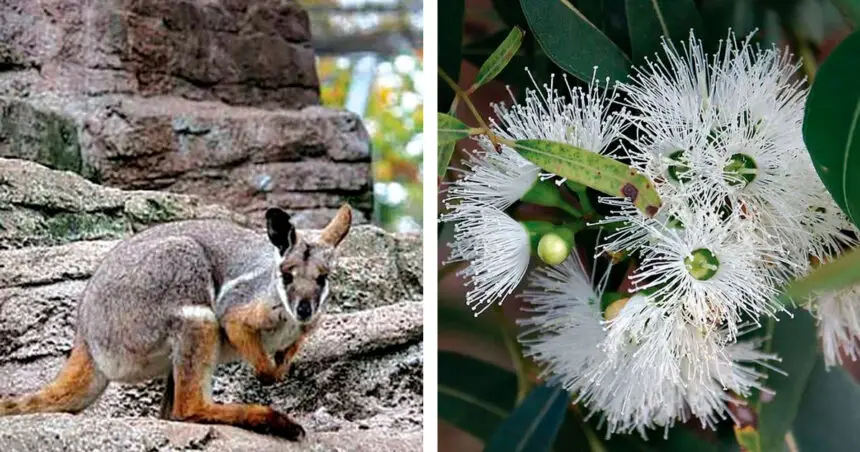
Both species are beautiful in appearance. Eucalyptus curtisii has the characteristic multi-trunked growth habit of mallee trees and its stems reveal beautiful colours after they shed their bark each spring. Being only around five metres high and typically having profuse creamy white flowers each October, they make ideal garden plants in well-drained soils.
Brush-tailed rock wallabies are short animals and typically have dense rufous or grey brown fur and a bushy black tail. They are amazingly agile in rocky terrain, which enables them to evade predators. They often emerge from among the boulders at night to feed in surrounding grasslands.
The Plunkett Mallee was chosen as Ipswich’s floral emblem due to its rarity in the wild and its suitability for urban planting. It is widely used as a street tree and in gardens, attracting local wildlife and allowing residents to enjoy its profuse clusters of flowers during spring. It represents both the natural heritage and conservation values of Ipswich, making it a fitting and celebrated floral emblem for the city.
While classified as near-threatened rather than threatened, Queensland Parks and Wildlife Service rangers are still concerned about the mallee’s long-term survival, because all its habitat areas are small and are subject to frequent fires and vandalism.
Prior to 1996, Ipswich’s floral emblem was the exotic bougainvillea, originating from South America. It was chosen in the 1930s, when exotic garden plants with bright flowers were the trend.