A TEENAGER left stranded in scorching heat at a suburban bus stop has become the face of a growing crisis in public transport accessibility, with serious questions now hanging over how such a failure was allowed to happen.
The February 18 incident unfolded at Willowbank, where Ipswich teenager Rhyley Schultz, who lives with Coffin-Lowry Syndrome, was travelling with his support worker on Route 515.
What should have been a routine transfer between services quickly turned into a distressing ordeal.
It is alleged that when Rhyley attempted to board his connecting bus, the driver refused to deploy the wheelchair ramp, leaving him stranded at the stop in extreme 35-degree heat.

Despite being a vulnerable passenger requiring assisted access, Rhyley was left behind.
An investigation later found the situation stemmed from a miscommunication between two drivers over passenger responsibility.
While alternative transport was reportedly offered, it was declined.
State Minister for Transport Brent Mickelberg described the incident as “unacceptable”, stressing that all operators are expected to provide safe, inclusive and accessible services.
But nearly two months on, the fallout continues to intensify.
State Member for Ipswich West Wendy Bourne has warned she is “not convinced” the same situation could not happen again, despite assurances from government and operators.
After being approached by Rhyley’s family, Ms Bourne escalated the matter to Parliament on March 5, lodging a formal Question on Notice to Mr Mickelberg.
Her questions went to the heart of the issue – whether operators contracted under the TransLink system can ignore what she described as a “no child left behind” principle, whether penalties would apply to Bus Queensland, and whether stronger disability training would be mandated.
The operator suspended the drivers involved during the investigation and has since been directed to review internal procedures.
But for Ms Bourne, and for Rhyley’s family, the response falls short.
Rhyley’s mother, Donna Schultz, said the ordeal highlights broader systemic failures, particularly in how frontline staff are trained to support passengers with complex needs.
Disability advocates have echoed those concerns, which extend beyond a single incident.
Another Ipswich resident, Bradley, alleged he and his wife were refused entry to a bus in North Booval while travelling with their service dog, claiming they too were left behind.
Media spokesperson for the Daniel Morcombe Foundation Harriet Minto-Day said: “While Daniel’s Law is specifically focused on child safety and not directly related to these incidents, the level of community engagement does reflect a growing expectation around safety, dignity and care for vulnerable people.”
For Rhyley, the experience has had a lasting emotional impact.
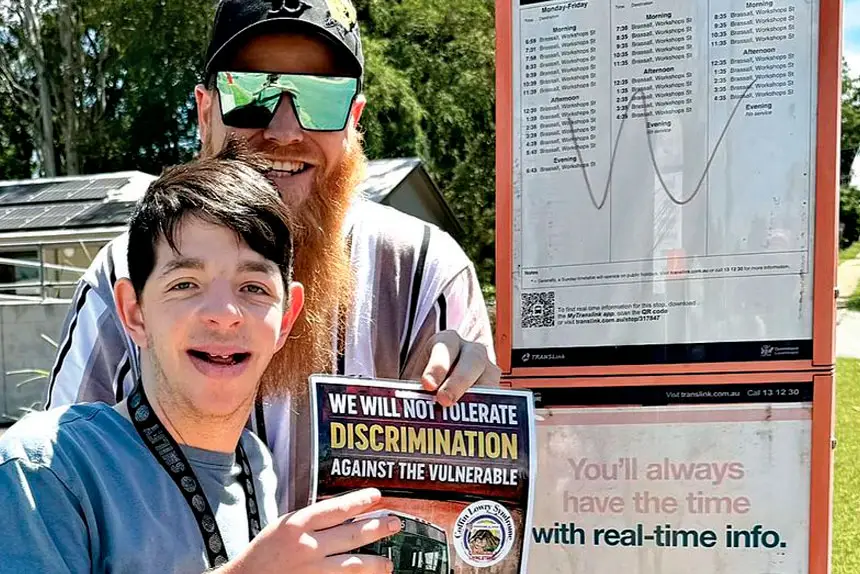
Once an enthusiastic bus user, he has since taken matters into his own hands – visiting bus stops along his route and placing posters declaring:
“We will not tolerate discrimination against the vulnerable. Equal access is a human right.”