
FEW suburbs in Queensland are changing as dramatically as Ripley.
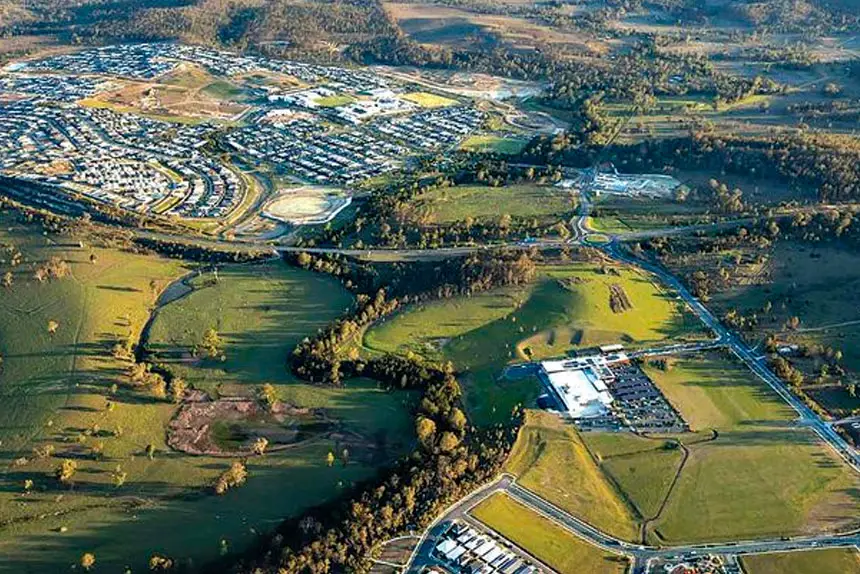
Located just minutes south of the Ipswich CBD in what was once a quiet farming district, Ripley is rapidly evolving into one of Australia’s largest and most ambitious master-planned communities.
Together with neighbouring South Ripley, the area has become the centrepiece of the Ripley Valley development, where new neighbourhoods, schools, shopping centres and major infrastructure projects are transforming the landscape almost as quickly as families are moving in.
For many, Ripley represents the future of Ipswich.

It is a suburb built on opportunity, where population growth is being matched by new schools, sporting facilities, retail precincts and transport investment. While cranes and construction sites dominate today’s skyline, planners are creating a city designed to serve generations to come.
When fully developed, the broader Ripley Valley is expected to be home to around 120,000 residents living in approximately 50,000 homes, making it one of Australia’s largest planned communities and one of South East Queensland’s most significant urban expansion projects.
For decades, little changed, as Ripley remained a peaceful rural locality on the outskirts of Ipswich, surrounded by grazing land and bushland.
That changed dramatically in 2007 when the Queensland Government identified the Ripley Valley as a Priority Development Area, paving the way for one of the country’s most significant urban developments.
Today, that vision is becoming reality, with the growth reflecting a broader transformation occurring across Ipswich, one of Australia’s fastest-growing cities.
Unlike many suburbs that evolve gradually over decades, Ripley is being built with a long-term vision from the ground up. Every new road, park, school and shopping precinct forms part of a masterplan designed to create a connected, self-sustaining city where residents can live, work, learn and play close to home.
At the heart of the community sits Ripley Town Centre, which has quickly become the commercial, retail and social hub of the growing Ripley Valley. Since opening its first stage in 2018, the centre has attracted supermarkets, cafes, restaurants, medical services, fitness facilities and specialty retailers, giving residents access to many everyday essentials close to home.
The transformation is far from complete, future stages of the $1.5 billion masterplan will continue expanding the precinct into a true regional town centre, incorporating additional retail, commercial offices, entertainment venues, community facilities, healthcare services and employment opportunities.
Earlier this year, the suburb was named in REA Group’s Hot 100 Suburbs for 2026, recognising it as one of Australia’s emerging property hotspots.
Investment analysts compare Ripley’s trajectory to neighbouring Springfield, itself regarded as one of Australia’s most successful master-planned cities.
While the numbers surrounding Ripley’s growth are impressive, it is the lifestyle emerging alongside the development that is helping define the suburb’s identity.
Despite becoming one of Queensland’s fastest-growing communities, Ripley has retained a strong connection to the natural environment. Parks, playgrounds, sporting fields, walking and cycling paths have been carefully integrated throughout new estates.
That balance between lifestyle and accessibility has become one of Ripley’s greatest strengths.
Families can enjoy modern schools, childcare centres, healthcare services, sporting facilities and shopping close to home, while remaining within easy commuting distance of Ipswich, Springfield and Brisbane.
As Ipswich cements its position as one of Australia’s fastest-growing regional cities, Ripley has become one of its defining success stories.