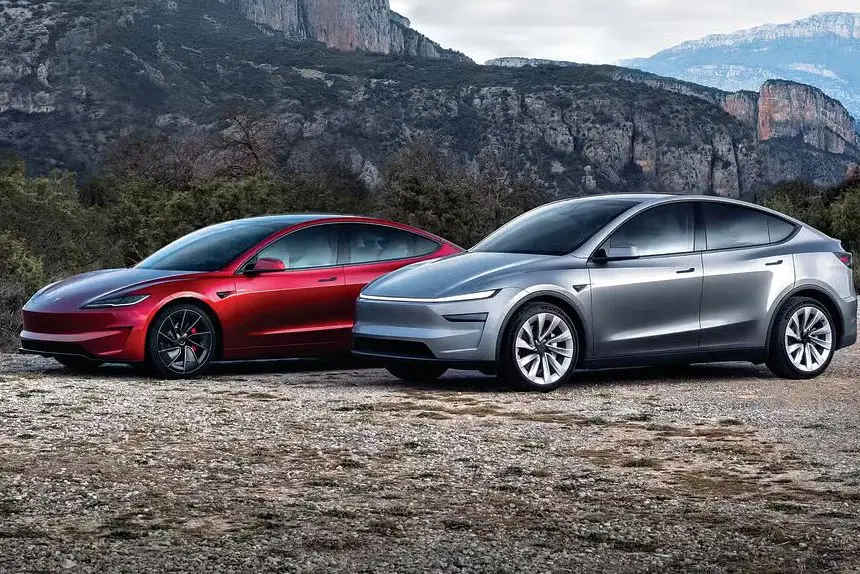
TESLA has signalled that the era of newly developed cars with steering wheels and pedals may be drawing to a close, as the electric vehicle brand doubles down on its vision of a fully autonomous future.
According to comments from CEO Elon Musk, the long-delayed next-generation Roadster may ultimately stand as the only exception, and potentially the final new Tesla designed for human control.
Musk claims the production version of the electric sports car will be revealed in April, nearly a decade after the concept was first unveiled in 2017.
“Long term, the only vehicles that we’ll make will be autonomous vehicles,” Musk told investors and media, adding that the Roadster is expected to debut later this year.
“Hopefully. It’s going to be something out of this world.”
Musk has previously predicted that, over time, as little as one per cent of kilometres driven by Tesla vehicles globally will be human-controlled, with the remainder handled by a future “unsupervised” version of the company’s Full Self-Driving software.
The Roadster’s anticipated reveal is expected to coincide with the start of production for the Cybercab, Tesla’s two-seat, purpose-built robotaxi that has been designed without a steering wheel or pedals.
Its arrival reinforces the likelihood that the Roadster will be the last new-generation Tesla vehicle to feature traditional driving controls.
Further insight into Tesla’s direction came from vice-president of vehicle engineering Lars Moravy, who responded to questions about the company’s plans for smaller, more affordable vehicles beneath the Model 3 and Model Y Standard.
Mr Moravy said Tesla would continue to reduce manufacturing costs without sacrificing range, performance or perceived quality, but acknowledged that investment priorities are increasingly shifting toward autonomy.
He said the introduction of the Cybercab represents a move toward providing “transportation as a service” rather than focusing solely on vehicle ownership.
“With Cybercab coming, we are aiming to bring that Tesla premium ride experience to our largest market yet, which could be five or 10 times our current levels of production,” Mr Moravy said.
“Of course, we do have plans for robotaxis in various shapes and sizes, but Cybercab will be the grand majority of that volume.”
Mr Moravy added that the Model 3 and Model Y Standard are Tesla’s least expensive vehicles ever and confirmed the company will continue expanding those models globally, hinting at a future rollout in markets such as Australia, where neither variant has yet been introduced.
Musk also reaffirmed that Tesla intends to develop larger autonomous vehicles beyond the Cybercab.
If it does finally arrive as promised, the Roadster may not just mark the return of one of Tesla’s most ambitious projects, but also the end of an era for driver-controlled Teslas altogether.